10 KPIs for Recruiters to Streamline the Hiring Process


Updated April 9, 2026
Life moves at the speed of light, and nobody knows that better than hiring teams. The only way to know if your talent acquisition process is efficient is by intentionally tracking the most important KPIs for recruiters.
By having a system in place to measure your recruitment KPIs, you can improve hiring efficiency to snag the best talent while still saving time, energy, and money.
What Are Recruitment KPIs?
In recruiting, Key Performance Indicators (KPIs) are measurable indicators that help you evaluate the overall performance of your hiring process.
Over time, tracking and analyzing your recruitment data can help you adjust your approach and keep ahead of the competition.
You can come across quality applicants with a good recruitment organization in record time. Analytics in recruitment can help you immensely in this process, making it an essential feature.
Having access to different recruitment KPIs is the ultimate way to optimize your hiring process to deliver the best results.
Recruitment KPIs vs Recruitment Metrics
While these two terms are often used interchangeably, they have an important difference.
Recruitment metrics are the raw data points you track throughout the hiring process, such as time to hire, cost per hire, or application completion rate.
Meanwhile, recruitment KPIs are the specific metrics you choose to focus on because they tie directly to your hiring goals and tell you whether your process is actually improving.
In other words, every recruitment KPI is a metric, but not every metric is a KPI. If your goal is to speed up hiring, time to interview might be a KPI.
If your goal is to improve hiring quality, retention rate or quality of hire may matter more. The difference comes down to relevance: KPIs are the metrics that matter most right now.
Which KPIs Should Recruiters Focus on Measuring?
To answer the question of which KPIs are the best for recruiters to measure, you first must know your own objectives. Depending on your current hiring objectives, you will want to track the metrics that will best help you:
- Reduce turnover
- Pull from a large or more diverse pool of candidates
- Attract higher-quality candidates
- Cut recruitment costs
- Streamline your hiring process
- Fill positions more quickly
The bottom line is this: When it comes to “the best” KPIs for recruiters, there is technically no right or wrong answer.
The most important KPIs are always the ones that measure progress toward whatever objectives you and your team are focusing on right now.

10 of the Most Useful KPIs for Recruiters
After examining your current hiring goals, you can determine which KPIs will provide you the most pertinent data. No matter your objectives, these ten are some of the most useful KPIs for recruiters.
1. Quality of Hire
When we discuss quality of hire, what matters here is not necessarily the total number of hires you make or the acceptance rate of those you interview, but more so the number of successful hires.
There isn’t a single approach to judging a successful hire, of course, but quality of hire can often be measured over time by looking at things like:
- Whether the employee proves to be a good fit for the position long term
- Whether the employee remains in the position for a long period of time after being hired
- Whether the hiring manager is satisfied with the hire
If you find that you’re filling positions quickly, but the hires don’t last, or the hiring managers aren’t quite happy with the fit, then you know you have issues related to quality of hire. Addressing these issues will help ensure your recruitment efforts are deemed a success.
2. Time to Interview
Time to interview is gauged by how much time passes between when the open position is announced and when the first interviews begin taking place. Analyzing this metric will let you know if your recruitment marketing is hitting the mark.
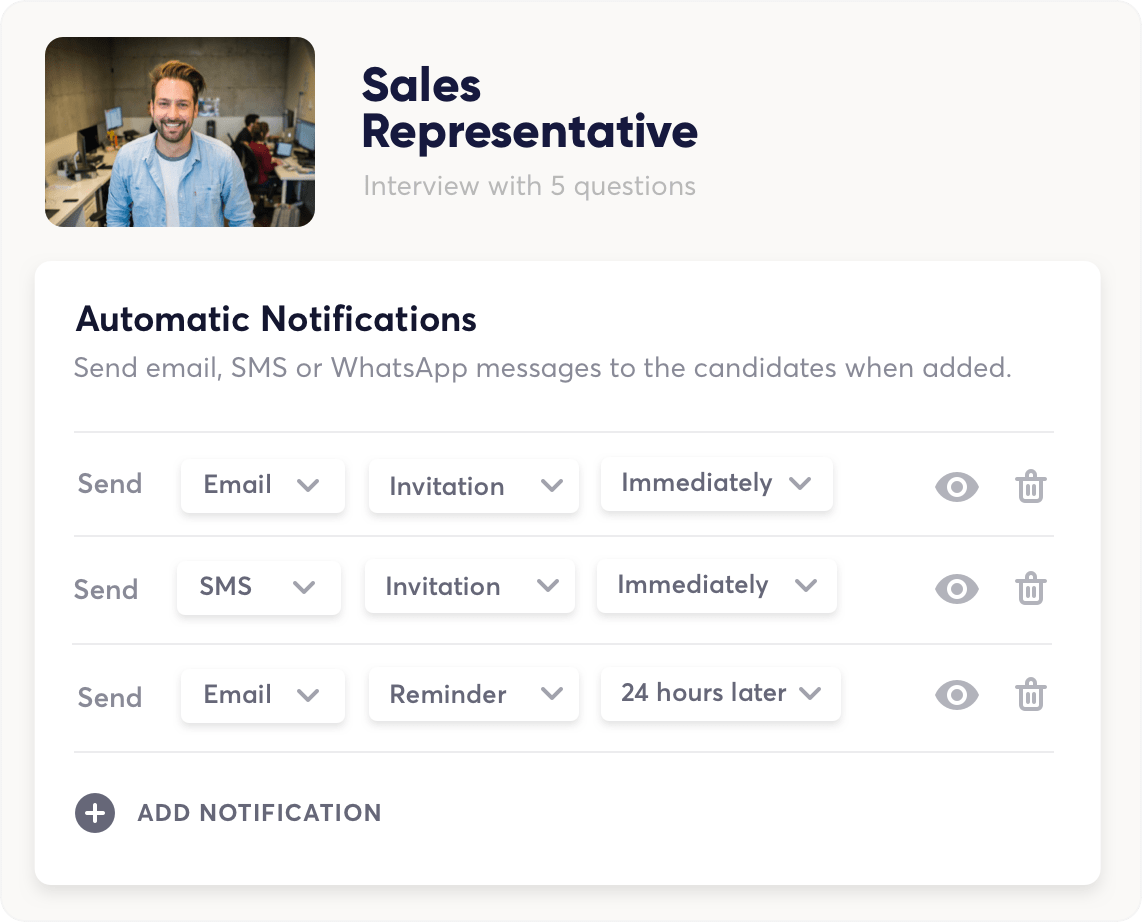
Because good people always get hired first, time to interview must be kept as short as possible.
The longer it takes you to set up and conduct interviews, the less chance you have to attract and land the best talent.
3. Time to Hire
The time between when a potential candidate is first contacted about a job and when they accept a job offer is referred to as time to hire.
The longer your time to hire lasts, the greater the chance the job seeker might go another direction and accept a different offer. Therefore, anything you do to speed the time to hire will increase your chances of hiring the best candidates.
4. Interviews per Hire
Interviews are the lifeblood of talent acquisition, yet they can prove extremely time-consuming.
You will generally need to interview a pool of candidates, yet the more interviews you conduct per job posting, the more time you’re spending to fill positions and the less efficient your process is.
Naturally, interviews per hire is among the top KPIs for recruiters to measure. As the term indicates, interviews per hire measures how many interviews you conduct before a hire is made.
If your ratio between the number of interviews and hires is too high, you may want to examine your application process and see if you should ramp up your screening methods so that you’re not wasting time and slowing down your hiring time.

5. Cost Per Hire
The cost-per-hire recruitment metric measures all expenses associated with a new hire, including:
- Advertising and recruitment
- Signing bonuses
- Onboarding and training
While costs related to filling a position vary widely depending on the industry, the average cost of hiring a new employee is around $4,000, according to a recent study .
While hiring a new employee is an important investment, your goal should always be to see the highest ROI.
This will reveal if your cost per hire is on the rise, while identifying areas in which you can reduce hiring costs.
Ways that recruiters can reduce cost per hire may include:
- Creating an internal employee referral program. Good people are often your best link to connecting with more good people. But this doesn’t happen by accident. Intentionally create a system by which your current employees can refer their contacts for open positions.
- Recruiting prospects via your social media channels. Many people spend large blocks of time online. Even if they’re not planning to visit job sites, they’re likely visiting Twitter, Facebook, or Instagram daily. With a bit of planning, you can leverage social media for cost-effective recruitment opportunities.
6. Source of Hire

Source of hire tells you where your successful candidates are coming from. This gives your recruitment manager valuable insight into which channels are actually producing results, so you can improve your recruitment strategy instead of spreading the budget evenly across every platform. It’s also one of the best ways to measure sourcing channel efficiency over time.
If you notice that one job board, referral program, or social platform consistently brings in more new hires than others, you can invest more confidently in that source.
On the other hand, if a channel generates lots of applicants but very few suitable candidate matches, it may be costing you time without delivering much value.
7. Offer Acceptance Rate
Offer acceptance rate measures how often candidates say yes after receiving an offer. This KPI can reveal whether your compensation, hiring speed, candidate experience, or overall recruitment strategy is strong enough to win top talent before another company does.
A low offer acceptance rate may point to issues like a slow process, poor candidate engagement, weak communication, or a mismatch between what was promised and what the role actually offers.
8. Application Completion Rate
Application completion rate shows how many candidates actually finish your application after starting it. This KPI is useful because it helps you understand whether your process is smooth and candidate-friendly or whether friction is causing people to drop off before they even enter your pipeline.

If completion rates are low, that could mean your application is too long, confusing, repetitive, or difficult to complete on mobile devices. It can also be an early signal that candidate satisfaction and candidate engagement are weaker than they should be.
A simpler process usually means more completed applications and a better chance of attracting a suitable candidate.
9. Retention Rate
The retention rate is judged based on the number of employees to stay with the organization over a pre-set amount of time. While you can pick any time frame, organizations often track their retention rate based either on quarterly or yearly blocks.
While quality of hire takes retention into consideration, a dedicated retention rate KPI examines solely whether the hires you have recruited stick with their jobs over the long term.
Retention rate is important to examine because it has implications for understanding how (or even whether) you’re managing to attract, train, and keep quality employees.
When employees stick with a company long-term, not only do their contributions become more valuable as they increase their skills and experience, but because positions have a low turnover rate, the company also does not have to invest time, money, or energy in seeking out and training replacements.
10. Adverse impact
Adverse impact helps you track whether your hiring process is affecting certain groups unfairly. This is an important KPI for any recruitment manager who wants to build a fairer recruitment strategy and make sure qualified candidates are being evaluated consistently at every stage.
By measuring adverse impact, you can spot patterns in screening, interviewing, testing, or selection decisions that may be filtering out certain groups at a much higher rate than others.
This gives you valuable insight into whether your process needs to be reviewed for fairness, compliance, and long-term hiring effectiveness.
3 Ways Hireflix Can Help Recruiters Hit Their KPIs
A one-way video interview software like Hireflix can help you streamline your process and ensure you’re hitting the KPIs in this post.
Hireflix has arguably the best video interview API and integrations on the market so you will be able to benefit from these improvements on your ATS/CRM without changing the way you work.
1. Hireflix helps you save time
Time is one of the biggest pressure points in hiring. Hireflix removes the back-and-forth of scheduling by letting candidates complete one-way interviews on their own time. That means your recruitment team can review responses when it suits them and move qualified candidates forward faster.
Check out the video below to learn how to start a Hireflix trial and how one-way video interviews can make your life as a recruiter much easier and more efficient:
2. Hireflix helps you attract better candidates
Top candidates don’t stay available for long. Hireflix creates a smoother, more flexible interview experience with no app downloads, no logins, and no scheduling hassles, so candidates are more likely to complete the process and stay engaged.
3. Hireflix helps you keep costs under control
Hireflix gives teams a focused way to screen candidates without adding unnecessary complexity or overhead. By helping recruiters save time, reduce manual work, and speed up hiring, it can lower cost per hire while still supporting a strong candidate experience.
Hireflix Can Help You Manage Your Recruitment KPIs
If you’re looking for ways to increase your recruitment efficiency, a great first step is to measure your efforts and the success of your application process and hiring rates.
The next best step is to partner with Hireflix.
Once you have the power of our exceptional one-way video software on your side, you can improve efficiency and save hundreds of work hours, all while attracting the most qualified candidate for each open job.
FAQs
What are KPIs in recruitment?
Key Performance Indicators (KPIs) are metrics that help you track the overall success of your recruitment process and gain insights on how you can improve effectiveness in key areas.
Though specifics vary according to hiring goals, common KPIs recruiters track may include quality of hire, time to interview, time to hire, interviews per hire, cost per hire, and retention rate.
Why are KPIs important in recruiting?
KPIs are important to track in recruiting because they give you a benchmark from which to judge your overall recruitment effectiveness. This is vital because if your pipeline is not as efficient as possible, you may face negative consequences.
Not only will you be expending unnecessary time and energy, but you’ll also be spending more money on your recruitment process while getting less accomplished than your competitors.
Worst of all, you could be consistently missing out on the top candidates since they only stay on the job market for a short amount of time.
How do you measure the performance of a recruiter?
You can measure the performance of a recruiter by tracking some key KPIs related to their pipeline, such as quality of hire, time to interview, time to hire, interviews per hire, cost per hire, and retention rate.
By tracking these metrics over time, you will be able to see what is working, understand what’s not, and gain insight into what adjustments you can make to right the ship.
What are the most important KPIs to monitor during the recruiting process?
When it comes to which KPIs to monitor during the recruiting process, there’s a sense in which there is no right or wrong answer. The most important KPIs to measure will always be the ones that will best help you meet your current hiring goals.
That said, common KPIs recruiters like to track include:
- Quality of Hire
- Time to Interview
- Time to Hire
- Interviews per Hire
- Cost per Hire
- Retention Rate
Before setting out to monitor your KPIs, always take time first to evaluate your goals and objectives for recruitment.
