AI Recruiting vs Automated Recruiting (and Why It Matters)

Recruiting teams hear "AI recruiting" and "automated recruiting" used as if they mean the same thing. But there’s actually some differences between the two.
This article breaks down what separates rule-based automation from AI recruitment and shows where each one can best help your recruitment process. Plus, you’ll get insights into how to use AI and automation together without overcomplicating your existing stack.
What Is Automated Recruitment?
Automated recruitment is rule-based technology that executes predefined workflows. You set the trigger, set the action, and the system runs the same way every time.
The system doesn't interpret context or adjust its behavior based on what's happening around it. It just follows the rules it was configured with. It doesn’t need judgment calls or exceptions unless you build one in.
Examples of Automated Recruitment
Automation already runs through most hiring workflows:
- Application confirmation emails that send the moment a candidate submits
- Interview scheduling links that go out once a candidate reaches a certain stage in the recruitment process
- Reminder emails that nudge candidates or hiring managers who haven't responded
- Pipeline updates that move a candidate from "applied" to "screening" to "interview"
- Status notifications that keep everyone in the loop automatically
Limitations of Automated Recruitment
Automation works best when the process is easy and predictable. Give it a clear trigger, a defined action, and a consistent endpoint, and it can handle repetitive tasks quickly at scale.
The limitation is that rule-based automation can’t make nuanced decisions. It can’t assess candidate fit, interpret the context behind a resume, or recognize when an application deserves a closer look.
When a step calls for judgment or a bit more flexibility, automation can fall short. Knowing which parts of recruitment require human input helps you use automation where it’s most effective.
What Is AI Recruiting?
AI recruiting, sometimes called AI recruitment, is technology that analyzes data, identifies patterns, or generates outputs to support recruiting work. Instead of following a fixed set of if-then rules, it works with probability and context.
What Sets It Apart From Automation
Machine learning and predictive analytics allow AI recruiting tools to compare candidate information with patterns linked to success in a particular role. The main difference here is flexibility.
Automation repeats the same action whenever a specific rule is triggered, while AI can evaluate different types of candidate data and adjust its output based on what it finds. It’s especially suited to tasks where the information varies from one candidate to another.
Common Use Cases
Most of the current excitement around artificial intelligence in hiring comes down to a handful of examples:
- Candidate matching, comparing a resume or profile against a job's requirements
- Candidate sourcing across larger talent pools, including passive candidates who aren't actively applying
- Personalized outreach, with generative AI drafting messages tailored to a candidate's background instead of one generic template
- Summarization of resumes and interview notes into something a hiring manager can review in minutes
- Candidate prioritization, flagging which applicants in a large pool deserve a closer look
The Need for Human Review

AI outputs still need human review whenever they could influence a candidate's advancement or a hiring decision. An AI system can suggest, rank, or summarize, but a human recruiter should be the one deciding who actually moves forward.
Recruiting teams run into trouble when they treat an AI recommendation as the final word instead of input to a human decision.
Key Differences Between AI Recruiting and Automated Recruitment
Once you know what each technology does on its own, the practical differences are easy to spot. Automation stays static until someone manually updates the rules. On the other hand, AI recruiting adjusts as the data it's working with changes.
Setup and Outcomes
Automation is usually simpler to set up. You define the trigger and action, test the workflow, and let it run. Meanwhile, AI recruiting tools often need more review upfront, especially when their outputs could influence hiring decisions. This could include checking for accuracy and bias before using them in a live process.
Success is measured differently too. Automation is judged mainly on reliability and time saved, while AI recruiting is judged on output quality, such as whether it surfaces relevant candidates, creates useful summaries, and supports sound recruiter decisions.
When Should You Use Automated Recruitment?
Automation works best when your main recruitment challenge is coordination or efficiency. Look for repetitive admin tasks, clear workflows, high volumes, and predictable next steps. If the process follows the same path each time, it’s usually a good candidate for automation.
Day-to-Day Tasks
Some recruiting tasks are especially well suited to automation:
- Interview scheduling that cuts down on back-and-forth
- Application confirmations sent as soon as someone applies
- Reminders and follow-ups based on candidate stage or wait time
- Pipeline updates that keep the applicant tracking system current
- Internal handoffs that alert recruiters or hiring managers when action is needed
Scaling Up
Automation becomes especially useful during high-volume hiring or busy recruitment periods, when manual coordination starts to take up too much time. Smaller teams scaling their hiring process often use it to handle routine tasks without adding more recruiting staff.
The key is to keep automation focused on predictable work. Tasks that require interpretation, judgment, or careful candidate assessment are better handled by AI recruiting tools or a human recruiter.
When Should You Use AI Recruiting?
AI recruiting is most useful when recruiters need help sorting through large amounts of information, prioritizing candidates, or making outreach more relevant. It can be especially helpful for difficult sourcing, large applicant pools, low response rates, and time-consuming review work.
High-Value Use Cases
Common uses for AI recruiting include:
- Candidate sourcing across larger talent pools, including passive candidates
- Candidate matching that compares skills and experience with role requirements to speed up resume screening
- Personalized outreach tailored to different candidate profiles
- Summarization of resumes, interview notes, and other recruiting information
- Candidate prioritization that helps recruiters decide which applicants to review first
Keeping a Recruiter in the Loop
These tools can take on much of the pattern recognition and analysis that would otherwise take recruiters hours to complete. That gives talent acquisition teams more time to focus on conversations, evaluation, and other work that depends on human judgment.

Recruiter review is still important, especially when AI output could affect which candidate moves forward. Match scores and ranked candidate lists should support a recruiter’s evaluation, not replace it. Human oversight is what keeps those outputs in context and helps prevent poor recruitment decisions.
How Can AI and Automation Work Together in Recruitment?
Most recruiting teams don’t need to choose between AI and automation. They work best together, with AI helping teams make sense of information and automation handling the next steps once a decision is made.
Prioritizing Candidates
AI recruiting tools can review a large applicant pool, identify stronger matches, and surface a shortlist for a recruiter to assess. Once someone moves forward, automation can handle tasks like sending interview invites, scheduling reminders, and updating the applicant tracking system.
Personalized Outreach & Delivery
AI can help tailor outreach based on a candidate’s background, experience, or role. Automation can then send those messages at the right time, trigger follow-ups, and keep the sequence moving without requiring recruiters to manage every step manually.
The goal is to make the hiring process simpler. If an AI recruiting platform or automation tool isn’t removing a bottleneck, reducing admin work, or giving recruiters more time for higher-value tasks, it’s probably not adding much value.
What Are the Common Mistakes to Avoid When Implementing AI and Automated Recruiting?
Even well-meaning teams run into trouble when they apply AI recruiting tools or automation to the wrong problem, or trust the output more than they should. Below are a few mistakes to watch for:
- Automating a broken process. If a workflow's unclear or inconsistent, automating it just makes the broken version run faster. Fix the process first, then speed it up.
- Using automation for judgment-heavy tasks. Keep rule-based tools focused on predictable, repeatable actions. Asking automation to assess candidate fit or read context means asking it to do something it was never built for.
- Adopting AI without a clear problem to solve. Choose an AI recruiting tool to solve a specific recruiting need, never just because it's new. A tool without a clear purpose tends to create extra work instead of saving any.
- Trusting AI output without review. When an AI recruitment tool's recommendation affects who advances in the hiring process, a human recruiter needs to stay involved. Treat a match score or ranked list as a final decision instead of an input, and you're one step from a bad hiring decision.
- Ignoring bias and transparency. AI systems trained on historical hiring data can repeat the same hiring bias baked into that data. Understanding how a tool's outputs get produced, and checking their impact on different candidate groups regularly, isn't optional.
The pattern underneath most of these mistakes is the same. Teams treat a technology's output as automatically trustworthy, when it still needs a human check.
What Role Should Humans Play?
No matter how capable AI recruiting tools and automation become, some parts of hiring still need human judgment.
The Recruiter's Role
Recruiters and hiring managers should remain responsible for decisions that go beyond the data, such as understanding a candidate’s motivation, assessing team fit, and making the final hiring decision. Technology can provide more information and make the process faster, but it shouldn’t replace the judgment behind those decisions.
Clear Ownership
Teams also need clear ownership of how these tools are used. Someone should review AI outputs before they affect a candidate’s progress, while another person makes sure automation rules continue to work as intended. If something goes wrong, whether it’s a questionable ranking or a scheduling error, there should be a clear process for stepping in and correcting it.
The Candidate's Experience
Candidates should still have real human contact at the moments that matter most, including interviews and the final decision. They’re also using AI themselves, whether to improve resumes or change how they prepare for interviews. This makes human judgment even more important on both sides of the hiring process.
Where Does Hireflix Fit?
Hireflix fits into the recruitment process by helping to automate screening interviews. It helps teams move applicants through the process efficiently without taking the final evaluation away from recruiters.
One-Way Interviews
Hireflix’s one-way video interviews let recruiters set standardized questions once, then invite candidates to record their responses on their own time. There’s no scheduling back-and-forth for a first-round screening call and no coordinating time zones. Invitations and reminders go out automatically, and recruiters review the recorded responses whenever it suits their schedule.
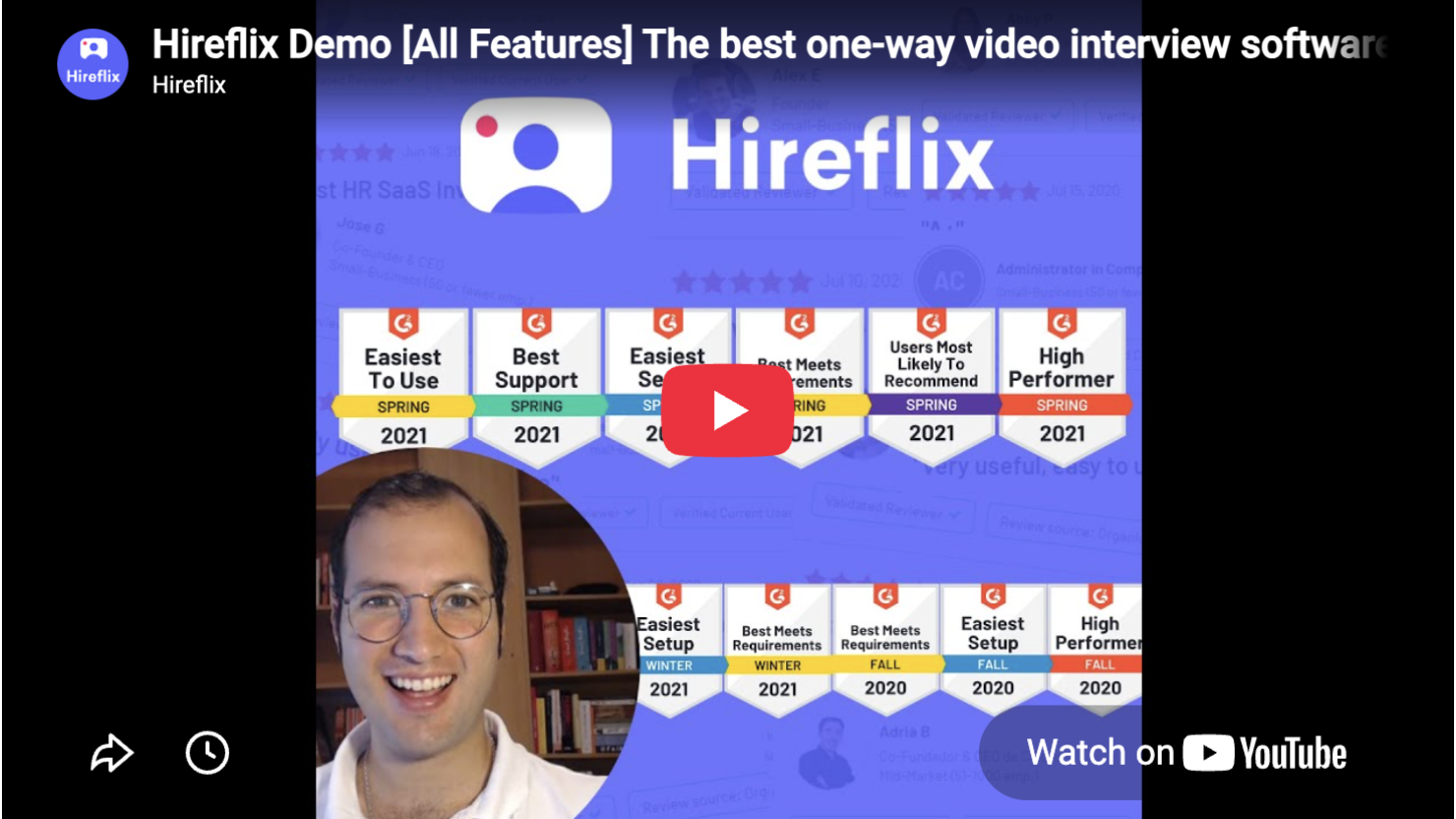
Watch a short demo to see how it works.
ATS and Workflow Integrations
Hireflix also connects with ATS platforms and other recruiting tools, including Greenhouse, Lever, Workable, SmartRecruiters, BambooHR, and Teamtailor. Integrations through Zapier and Make extend those workflows further, while its API and webhooks allow teams to build Hireflix into a broader recruitment process.
That means a candidate sourced or matched through an AI recruiting tool can move into a Hireflix screening stage, with Hireflix automating the invites and reminders.
AI Recruiting or Automated Recruiting: Which Should You Choose?
The choice comes down to what you need the technology to do. Use automation for repetitive tasks like scheduling, reminders, confirmations, and status updates. Then use AI recruiting when the work involves analysis or prioritization, such as sourcing candidates, summarizing information, or sorting through a large applicant pool.
In practice, most recruiting teams use both. AI and automation aren't competing for the same role. They support different parts of the hiring process and work best when each is used where it makes the most sense.
Try Hireflix's one-way video interviewing to make screening more efficient while keeping human judgment focused on the decisions that still need it.
