How to Scale Your Hiring Process Without Chaos: The Guide for SMBs

Scaling hiring sounds simple until the process starts breaking under pressure. More open roles, more applicants, and more moving parts can quickly turn a manageable workflow into a slow, messy one.
This guide breaks down what scalable hiring actually means, why SMB hiring processes often crack during growth, how to improve hiring efficiency before adding headcount, and how to build a process that can grow with your business.
What Does It Mean to Scale a Hiring Process?
Scaling a hiring process means handling more hiring demand without sacrificing quality, speed, or consistency. It is not just about filling roles faster.
It is about building a process that can support more applicants, more open roles, and more activity without becoming disorganized.

For SMBs, that usually means moving beyond informal hiring habits and building a more repeatable system. As growth increases, clearer stages, stronger screening, and better ownership become necessary to keep the hiring process manageable.
What Causes SMB Hiring Processes to Break During Growth?
Most SMB hiring problems during growth are operational. As hiring volume rises, the same weak spots tend to show up again and again. The following are the most common breakdown points:
- Manual coordination — Too much back-and-forth becomes harder to manage as hiring volume increases.
- Inconsistent screening — Uneven evaluation makes it harder to compare candidates accurately at scale.
- Delayed feedback — Slow input creates bottlenecks when lean teams are handling more open roles or applicants.
- Unclear ownership — Confusion around responsibilities becomes more disruptive when team capacity is already stretched.
The bigger issue is that these breakdowns add up. One delayed feedback loop or unclear hiring decision may seem manageable on its own.
But when the hiring team is balancing multiple job postings, passive candidates, employee referrals, and interview scheduling across several roles, those small gaps start slowing the entire recruitment process down. That is why scaling hiring usually fails because of process drag, not lack of effort.
Core Building Blocks of a Scalable Hiring Process
A hiring process needs a few foundational pieces in place before you add more tools or more people.

The core pieces of a scalable hiring process are the ones that keep the team aligned as hiring demand grows. When these are clearly defined, the team can stay more aligned even during high-volume hiring.
- Defined hiring stages — Give candidates a clear path through the process instead of a different experience for every role. They also help the hiring team know what should happen at each step and when.
- Interview structure — Make sure interviewers are evaluating the same things instead of improvising every conversation. That creates fairer comparisons and stronger decision-making.
- Communication workflows — Help candidates know what to expect while reducing the need for recruiters to rewrite the same updates every day. They also make the process feel more organized and predictable from the candidate side.
- Decision ownership — Clarifies who is screening, who is evaluating, and who makes the final hiring decision. This reduces confusion and keeps the process moving when multiple people are involved.
These building blocks matter because they create repeatability. When hiring demand grows, consistency becomes one of the biggest advantages an SMB can have.
What that means for SMB operations
For smaller companies, the foundations usually also include onboarding readiness, recruiter alignment, and hiring-manager participation. If the recruiting process speeds up but onboarding is still improvised, the system still breaks later.
If the recruiter understands the role but hiring managers are not aligned on what success looks like, candidate profiles become harder to compare and the hiring process slows anyway.
These foundations need to be in place before the business invests more heavily in automation, additional headcount, or a more complex applicant tracking system.
How SMBs Can Scale Hiring More Efficiently
Scaling hiring more efficiently does not always mean adding more recruiters right away. Often the biggest gains come from better workflows, clearer ownership, and fewer manual steps.
That is especially true for SMBs, where the same recruiter or HR team may already be balancing recruiting, communication, and interview coordination across the business.
Standardize communication across the hiring process
More consistent communication helps SMBs reduce delays and keep candidates moving through the process without constant back-and-forth.
Using clear templates, response timelines, and shared expectations makes the hiring process easier to manage and gives both recruiters and hiring managers a more reliable system to work from.
Reduce repetitive work that slows the team down
Hiring becomes harder to scale when recruiters spend too much time on scheduling, coordination, and other repetitive tasks that do not improve the hiring decision.
SMBs usually get better results when they remove unnecessary manual work and protect recruiter time for candidate screening, evaluation, and communication that actually moves hiring forward.
Tighten handoffs and clarify feedback ownership
A lot of hiring delays happen between stages, especially when hiring managers are unsure when to step in or what kind of feedback they need to provide.
Clearer handoffs and better-defined ownership make the process easier to manage at scale because candidates are less likely to get stuck waiting for internal alignment.
Use one-way screening interviews
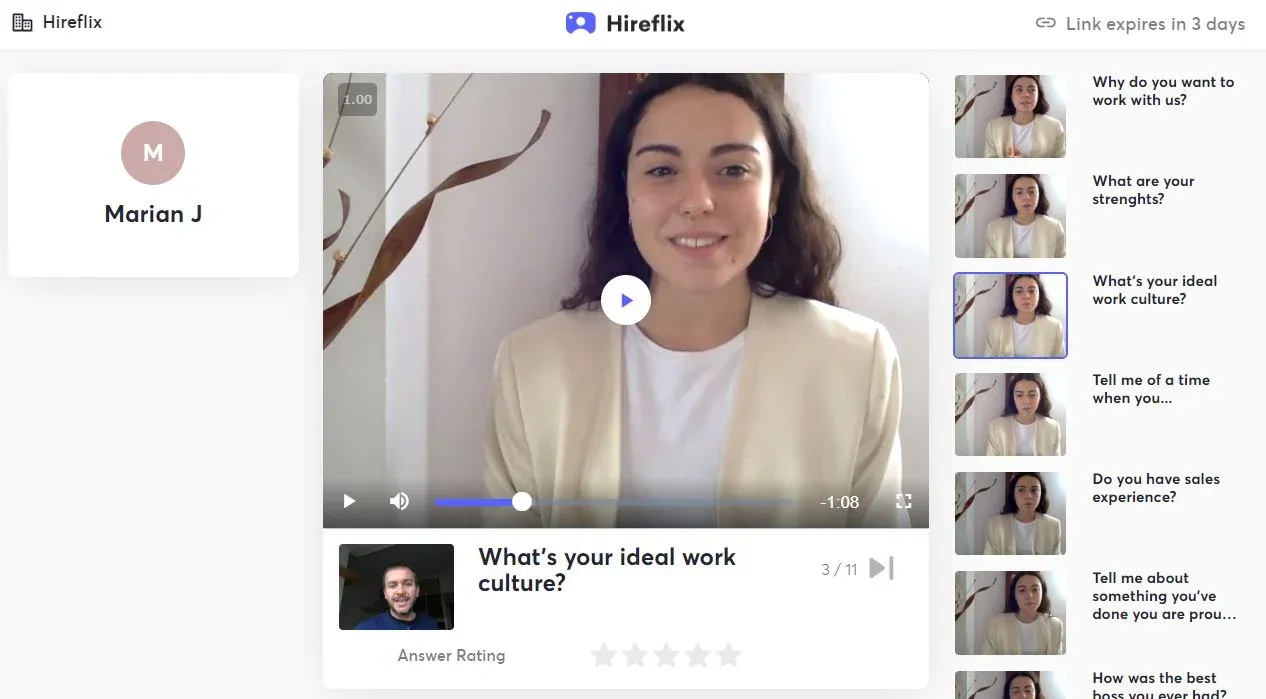
Using stronger screening interviews can make candidate review more consistent before the team spends time on live interviews. For SMBs, this is helpful because early-stage screening is often one of the first places the process starts to drag.
This is where Hireflix can help. Hireflix is a one-way video interview software that helps hiring teams review candidates on their own time, share recorded interviews, and avoid the scheduling burden that slows early-stage screening.
Want to see how Hireflix works in practice? Watch the demo to explore its features and workflow.
What Does a Scalable Hiring Process Look Like for an SMB?
A scalable hiring process needs to be repeatable. For SMBs, a simple stage-by-stage model is often the easiest way to keep the process organized as hiring demand grows.
A practical SMB model usually includes the same core stages, even if the details vary by role or team size.
Role kickoff
Align on the role’s goals, requirements, success criteria, and job description before sourcing begins. This creates a clearer starting point for everyone involved and reduces confusion later in the process.
Sourcing
Build a candidate pipeline through the channels that fit the role, whether that includes a job board, employee referrals, social media, or direct candidate sourcing. The goal is to bring in relevant candidates through sources the team can manage consistently.
Screening
Review applicants through a consistent first-stage process to narrow the pool efficiently. When deeper evaluation is needed, a more structured assessment interview approach can make screening more useful and repeatable.
Interviews
Use structured interviews to assess candidates against the same role-relevant criteria. This makes evaluation more consistent and helps teams compare candidates more fairly.
Decision-making
Gather feedback quickly and use clear ownership to move toward a final hire decision. A scalable process depends on timely input and fewer delays between stages.
Onboarding handoff
Transition the selected new hire into onboarding with clear next steps and shared context. This helps the process continue smoothly after the hiring decision is made.
What makes this model scalable is that every step is clear. Candidates know what to expect, recruiters know what needs to happen next, and hiring managers know when they need to weigh in. That kind of repeatability is what turns a busy hiring process into a scalable hiring strategy.
What Role Should Automation and Hiring Technology Play?
Recruitment automation should reduce friction, not add it. The right hiring technology helps with repetitive admin work, better coordination, stronger visibility, and cleaner handoffs across the recruitment process.
For SMBs, hiring technology is most helpful when it solves everyday process problems without adding extra weight. The best use cases are usually the ones that save time, reduce manual coordination, and make it easier for recruiters and hiring managers to stay aligned.
The most useful applications usually include:
- Interview scheduling — Helps reduce back-and-forth and makes it easier to move candidates through the process without delays.
- Workflow visibility — Gives recruiters and hiring managers a clearer view of where each candidate stands.
- Handoffs between recruiter and hiring manager — Keeps ownership and next steps clear as candidates move through the hiring process.
- Candidate management — Makes it easier to track applicants, organize candidate profiles, and avoid losing momentum.
- Structured screening — Helps teams assess candidates more consistently before investing time in live interviews.
- Communication templates and reminders — Reduce repetitive admin work and help keep candidates informed throughout the process.
The goal is to remove the repetitive work that keeps human judgment from being used well. If the right tools simplify recruiting, they support scalable hiring. If they create more processes than the team can realistically manage, they slow it down.
Which Metrics Show Whether a Hiring Process Can Scale?

If you want to know whether a hiring process is actually scalable, the metrics below can help you measure both speed and process health. Together, they give you a clearer view of whether the process can handle more hiring demand without creating more friction.
Time-to-hire
Time-to-hire shows how long it takes to move a role from opening to accepted offer. It helps teams see whether the process is moving at a pace that can support growing hiring demand.
Screening throughput
Screening throughput tracks how many candidates the team can review efficiently within a set period. This helps show whether the early stage of the process can handle higher volume without slowing everything down.
Candidate drop-off
Candidate drop-off shows where candidates leave the process before reaching the next stage. It helps teams identify friction points that may be hurting conversion or creating unnecessary delays.
Stage conversion
Stage conversion measures how many candidates move from one stage to the next. This helps assess screening quality, funnel strength, and whether the process is filtering candidates effectively.
Hiring-manager response time
Hiring-manager response time measures how quickly hiring managers provide feedback after interviews or screening steps. It helps reveal whether internal delays are slowing the process more than sourcing or recruiting capacity.
These metrics matter because they show whether the system is absorbing more volume well or simply pushing the bottleneck somewhere else. Metrics are most useful when they lead to action.
For example, if screening throughput is low, the team may need a better screening format. If candidate drop-off rises after the application stage, the issue may be the job ad or application flow.
If hiring-manager response time is lagging, the problem is likely internal process discipline, not candidate sourcing. That is why measurement is more than reporting. It helps refine the hiring process as the business scales.
Build a Hiring Process That Can Grow With Your Business
Scalable hiring comes from stronger systems, not just more effort. As SMBs grow, the hiring process needs to become more repeatable, more visible, and easier for recruiters and hiring managers to run without constant manual coordination.
For SMBs that need to scale early-stage screening without adding more manual work, Hireflix is a strong fit. Its one-way video interview format helps teams review more candidates in less time, reduce scheduling friction, and create a more consistent way to assess talent before live interviews begin.
That kind of structure makes scaling hiring feel more manageable, especially when growth starts putting pressure on the recruiting process.
