Retail Recruiting Strategies for Faster, Smarter Hiring

Retail hiring moves fast, and the wrong process can slow everything down. Teams often need to fill multiple roles at once, respond quickly to local demand, and keep strong applicants from accepting another offer first.
In this article, you’ll learn what retail recruiting involves, why it comes with unique hiring pressure, and which practical strategies can help retail teams hire faster and more consistently.
Because Hireflix focuses on improving candidate screening, we see where retail hiring often stalls and what helps teams move qualified candidates forward with less friction.
What is Retail Recruiting?
Retail recruiting is the process of attracting, screening, and hiring workers for retail roles across management, customer service, and support functions.
In practice, that can include hiring for a cashier, sales associate, stock staff member, supervisor, store manager, or any other retail position needed to keep a retail business running smoothly.

What makes retail recruitment different is its usual focus on speed, volume, and location-based hiring. Many roles in the retail sector do not follow long, specialized hiring cycles.
Instead, recruiters and hiring managers often need to respond quickly, process many applicants, and keep the recruitment process simple enough for high-volume hiring. That makes retail recruiting less about long evaluation windows and more about building a hiring strategy that can keep up with demand.
Why Retail Hiring Requires a Different Recruiting Approach
Retail hiring comes with pressures that many other teams do not face as often. The biggest differences usually come down to turnover, seasonal demand, and outdated hiring workflows.
High turnover is an unavoidable
One of the biggest challenges is turnover. A portion of every retail workforce is students who'll head back to school in the fall and people working their first job who haven't figured out what they want to do long term.
Even for those who choose retail as their career, the schedule and physical demands of retail work add up over time. This means a retail recruiter (often the store manager) has to backfill the same retail role repeatedly, creating constant pressure to hire quickly without letting the process become inconsistent.
Seasonal demand requires faster high-volume hiring
Seasonal demand creates another challenge. Retail organizations may suddenly need more retail workers around holidays, promotions, or other increased traffic periods.
When that happens, the hiring team needs a recruitment strategy that can support high volume hiring without overwhelming the recruiter or slowing candidate movement.
Manual hiring steps slow candidate movement
Many retailers also still deal with manual hiring steps that make speed harder to maintain. If application review, interview scheduling, and candidate follow-up depend too heavily on back-and-forth coordination, the hiring process becomes slower than it needs to be.
In retail, that delay can be costly because strong retail candidates often apply to multiple employers at once and move on quickly when the process feels disorganized.
Practical Retail Recruiting Strategies for Faster Hiring

Retail hiring gets easier when teams focus on the parts of the process that most affect speed, consistency, and candidate movement. The strategies below can help retail organizations reduce delays, improve screening, and build a more dependable hiring workflow.
1. Attract the Right Retail Candidates Earlier
One of the most useful retail strategies is improving attraction before a role becomes urgent. If a retail company waits until it is already understaffed to start building interest, it loses valuable time. A strong retail recruitment strategy starts with clear job messaging and top-of-funnel visibility.
Make retail roles clear and relevant
A good job posting should help a job seeker understand what the retail job actually involves. That means being specific about schedule expectations, pace of work, customer service demands, physical tasks, and growth opportunities. Clearer messaging helps potential candidates decide faster whether the role fits.
It also helps to reflect what retail talent cares about most. Depending on the retail industry and market, that may include flexibility, team environment, stability, competitive compensation, or advancement potential.
When the message feels relevant, it becomes easier to attract more qualified candidates instead of generating noise from people who are not a fit.
Be loud about the perks
If you offer something that stands out, like pay, schedule, days off, or discounts, put it front and center in the job posting. For example, Target’s reputation for paying well does a lot of recruiting work on its own. Hobby Lobby is closed on Sundays, guaranteeing at least one weekend day off, which can be hard to find in the industry.
If you offer above-average pay, employee discounts, tuition assistance, or promotion opportunities, make sure your candidates know.
Expand reach with targeted applicant generation
Retail hiring improves when teams widen visibility in deliberate, role-relevant ways. Instead of relying on one channel or restarting every search from scratch, recruiters can use a mix of targeted outreach methods to reach retail candidates earlier and keep the talent pool active.
- Referrals — Encourage current employees to recommend people who already understand the pace and expectations of retail work.
- Location-specific campaigns — Target candidates in the exact areas where hiring demand is highest.
- Repeat seasonal outreach — Reconnect with past seasonal workers who may be open to returning.
- Local promotion — Use community-based visibility to attract applicants already familiar with the store.
- Outreach to past applicants and previous hires — Re-engage people who were already interested and may still be a fit for the role.
Instead of restarting from zero every time, recruiters can build a talent pool from people who are already open to the opportunity.
2. Reduce Hiring Delays in the Retail Process
Retail hiring speed often depends less on sourcing and more on what happens after someone applies. A slow application-to-interview path can weaken conversion before screening even begins.

Simplify the path from application to next step
One of the biggest causes of delay in retail hiring is unnecessary friction between the application and the next step. If the process feels slow or difficult, candidates are likely to lose interest before screening even begins.
- Long forms — Ask for too much upfront and make quick applications feel like extra work.
- Repeated data entry — Force candidates to re-enter information they already submitted.
- Unclear instructions — Leave applicants unsure about what to do next or how the process works.
- Non-mobile-friendly workflows — Make it harder for retail candidates to apply quickly from their phones.
For a retail team managing high-volume hiring, mobile-friendly and easy-to-complete workflows matter because many candidates are applying quickly and comparing multiple opportunities at once.
Move faster once candidates enter the funnel
Retailers also need fast internal handoffs. If the application review sits too long or the hiring manager takes too much time to confirm next steps, strong candidates may accept another offer first. Clear expectations between recruiter, hiring manager, and store leadership can shorten delays and keep the recruitment journey moving.
3. Use Structured Screening to Handle Candidates More Efficiently
When many applicants enter the funnel at once, retail recruiting becomes harder to manage through informal screening alone. Structured screening helps teams move faster while keeping the process fair and easier to compare.
Standardize early-stage evaluation
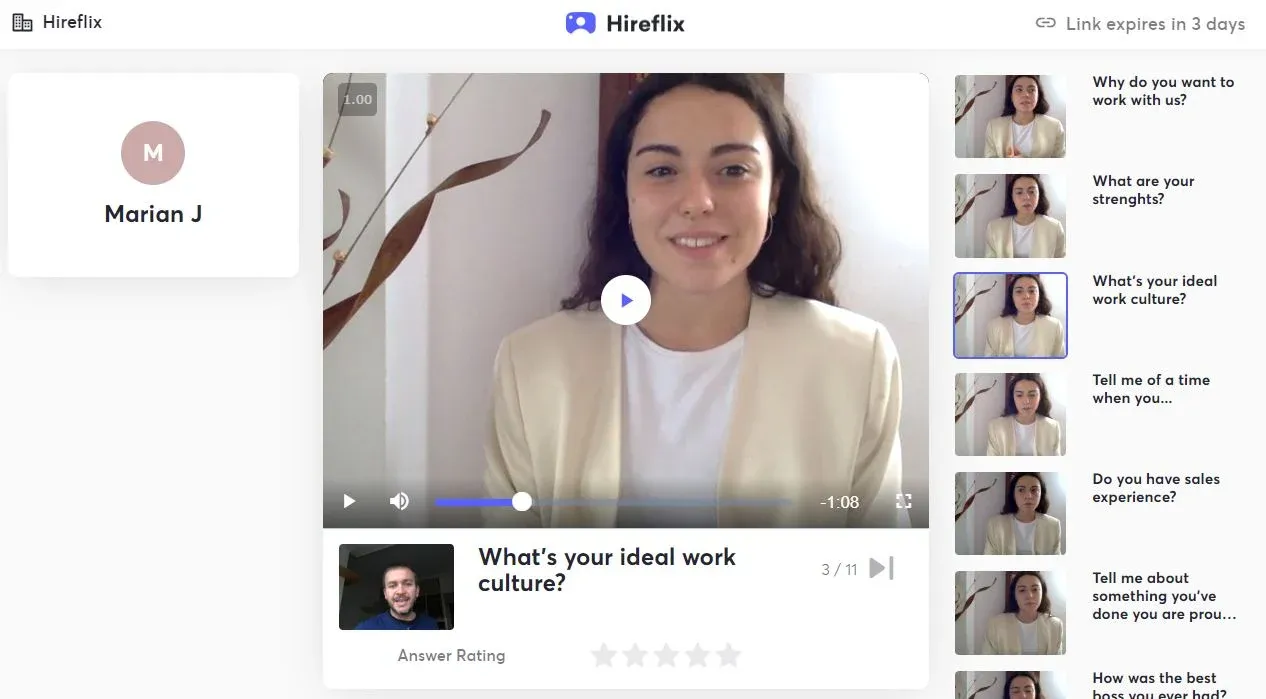
Retail teams can save time by using repeatable screening questions and shared criteria across similar roles, such as retail sales associate, stock staff, and supervisor positions. When candidates respond to the same core questions, the hiring team can compare applicants more easily and avoid relying too much on inconsistent first impressions.
Structured screening is especially useful when hiring across multiple locations. It gives a retail organization a more dependable way to review candidates without creating a different process for every store or manager.
Use Hireflix to reduce scheduling friction
Hireflix is a one-way video interview software purpose-built for early stage screening. Candidates complete the interview on their own time, then recruiters and hiring teams review responses asynchronously. This allows faster screening, eliminates scheduling back-and-forth, and supports collaboration across the hiring team.
That makes it especially useful for store associate hiring, seasonal surges, and multi-location retail hiring where live scheduling can slow everything down.
Hireflix also supports automated communication through email, SMS, and WhatsApp, which helps teams keep candidates informed while reducing manual follow-up.
Want to see how Hireflix works in practice? Watch the demo to explore its features and workflow.
4. Improve Candidate Experience During High-Volume Hiring
A strong candidate experience matters in retail because applicants often have several options at once. If the process feels disorganized, people lose interest quickly.
Keep communication clear throughout the process
Retail applicants should not be left guessing after they apply or complete a screening step. Timely updates, clear next steps, and realistic timelines help candidates stay engaged. Even simple communication improvements can reduce candidate drop-off and make the recruitment process feel more organized.
Protect employer perception while moving quickly
Hiring speed matters, but so does how the process feels. A retail business can move fast without making candidates feel rushed or ignored. Clear instructions, respectful communication, and fewer friction points help create a stronger candidate experience, which in turn supports customer experience and employer perception. In retail, where local reputation matters, that can influence future attraction as much as the current hiring cycle.
5. Measure What Makes Retail Recruiting More Effective
Retail recruiting gets easier to improve when teams can see exactly where speed and candidate movement start to break down. The right metrics help hiring teams move beyond guesswork and spot the points where the process needs attention most.
- Time to screen — Shows how quickly applicants move from applying to early evaluation.
- Time to hire — Helps reveal whether the overall hiring process is moving fast enough.
- Completion rates — Indicates how many candidates actually finish key stages of the process.
- Candidate drop-off points — Shows where applicants lose interest or exit before completion.
Looking at these patterns helps teams identify whether delays come from sourcing, communication, screening, or internal decision-making. For multi-location retailers, it also helps compare differences by store, season, or role type.
Refine the process using what the data shows
Once those patterns are visible, the recruitment strategy becomes easier to improve. If one location loses applicants after the first step, that workflow may need simplification. If one role attracts many applicants but few qualified candidates, the job posting may need stronger targeting.
The goal is not to make the process heavier. It is to use data to support smarter retail hiring and more consistent results over time.
Build Faster Retail Recruiting Workflows With Hireflix
The best retail recruiting strategies combine clear attraction, fast movement, structured screening, strong candidate experience, and ongoing process improvement.
Hireflix fits into that broader strategy at the screening stage. Its one-way video interviews help retail teams review more candidates in less time, reduce scheduling friction, and move applicants forward more consistently.
Hireflix also supports faster screening, easier sharing across hiring teams, and automation features that improve candidate communication during early-stage evaluation. If screening speed is your biggest retail hiring bottleneck, Hireflix is worth exploring as a practical way to make the process faster and easier to manage.
FAQs
What is retail recruiting?
Retail recruiting is the process of attracting, screening, and hiring workers for retail roles across management, customer service, and support functions, with a usual focus on speed, volume, and location-based hiring.
Why does retail hiring require a different recruiting approach?
Retail hiring faces unique pressure from high turnover, seasonal demand spikes, and manual hiring steps that slow candidate movement while strong candidates apply elsewhere.
How can retail teams use structured screening to hire more efficiently?
Retail teams can use repeatable screening questions and shared criteria across similar roles, and tools like one-way video interviews let candidates respond on their own time while recruiters review asynchronously to eliminate scheduling friction.
