Campus Recruitment: How to Attract and Hire Top Student Talent

Campus recruiting rewards the companies that show up early and stay in touch. But companies that wait often face a much more challenging market for the remaining top talent.
This guide covers what campus recruitment is, why hiring students works differently from hiring experienced professionals, and how to build a strategy that survives the academic calendar.
What Is Campus Recruitment?
Campus recruitment is the process of hiring students and recent graduates directly from colleges and universities, usually for internships, graduate programs, apprenticeships, or entry level positions.
It's a long game built on relationships with schools, visibility with students, and a talent pipeline you grow one cycle at a time.
Brand building and hiring at the same time
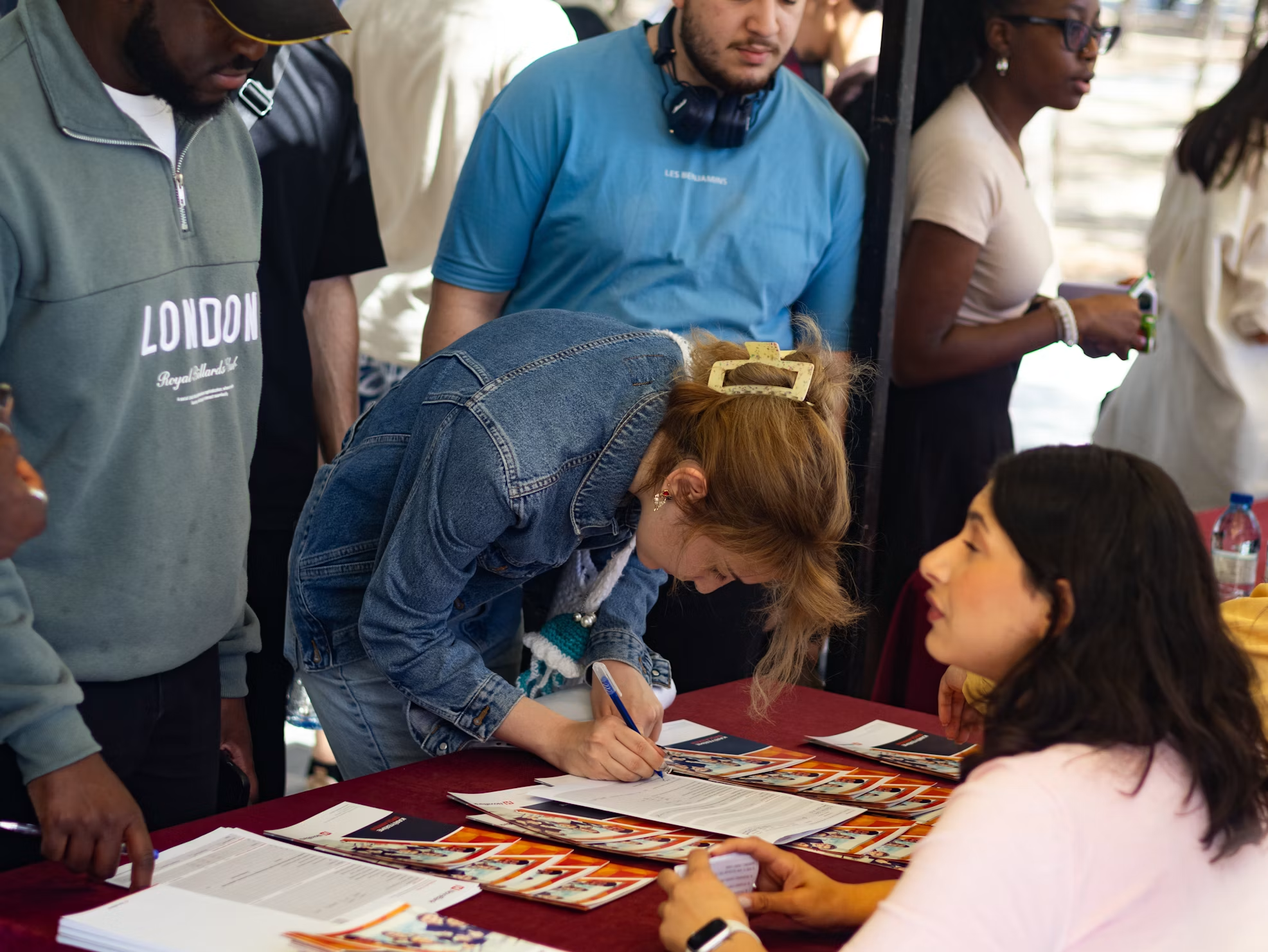
Attending a career fair is the part everyone pictures, but it's actually the smallest part of the job. Campus recruiting runs on two tracks at once.
- Employer-brand activity – information sessions, a campus visit, sponsored student club events, content placed where students actually look.
- Active hiring – posting a job opening, running campus interviews, screening applicants, and extending a job offer before a competitor does.
Teams that do only the first build awareness and can end up not hiring anyone. And teams that do only the second turn up cold in the spring and wonder why the strongest college students have already signed elsewhere.
Where the current job market stands
Employers expect to increase hiring from the Class of 2026 by 5.6%, according to NACE's Job Outlook 2026 Spring Update, a sharp revision upward from the flat 1.6% projected in the fall. Those gains cluster at the top, with organizations of more than 5,000 employees raising new-graduate hiring by 8.7%.
Internships are where much of that hiring gets decided. NACE's 2026 Internship & Co-op Report puts the average intern conversion rate at 63.1%, the highest mark in five years. If you run internship programs, they aren't a side project. They are your main channel for filling entry level jobs.
What Is a Campus Recruiter and What Do They Do?
A campus recruiter owns the relationship between a company and the schools it hires from. The role blends event work, brand work, partnership management, and the unglamorous screening machinery that turns a crowd of interested students into a short list.
In a typical week, campus recruiters are:
- Liaising with colleges: Staying in regular contact with career services teams so roles reach the right students at the right moment.
- Attending career fairs and recruiting events: Working the booth, and also deciding which events are worth the travel budget.
- Hosting information sessions: Giving students a real look at the work, the team, and the career path on offer.
- Maintaining employer branding: Keeping the company's story consistent across campus events, social channels, and every conversation a student has with the team.
- Securing campus partnerships: Building formal relationships with departments, faculty, and student organizations.
- Engaging talent communities: Keeping in touch with interested students who aren't ready to apply yet.
- Implementing screening workflows: Designing an interview process that can absorb hundreds of applicants without collapsing.
Notice how much of that happens before anyone applies. Campus recruitment starts a year or more ahead of the job opening, because students form opinions about employers long before they begin a job search.
What Are the Benefits of Campus Recruitment?
The case for campus recruiting comes down to timing and repeatability. None of it pays off inside a single quarter, and that slow compounding is why skipping a year costs more than it saves.
Earlier access to fresh talent
Reach students and recent graduates before they move further along with other employers. The strongest college talent commits early, often well before graduation.

A stronger pipeline for internships and entry-level roles
Build a recurring source of early-career candidates instead of restarting each cycle from zero. Last year's interns became this year's shortlist.
Better long-term talent planning
Invest in young talent now and you have a more reliable way to fill roles two and three years out. Succession planning gets easier when the bench already exists.
Higher employer visibility on campus
A consistent campus presence builds brand awareness with students who become job seekers soon enough. Familiarity can pull a lot of weight in the moment someone decides where to apply.
Stronger relationships with schools and career centers
Connections with career services support future outreach, recruiting events, and hiring cycles. A career center that trusts you will send strong students your way unprompted.
More direct access to student talent communities
Campus programs, student groups, and university networks put you in front of potential candidates who'd never find your job postings. These students aren't job hunting yet, which is precisely why reaching out to them works.
Why Campus Recruitment Requires a Different Hiring Approach
Hiring an experienced professional and hiring a college senior are two different problems that happen to share a job title. Run campus recruiting the way you run experienced-hire recruiting and you'll screen out the best people in your own pipeline.
Potential is the thing you're measuring
Student candidates have thin résumés by definition. A college senior might have one internship, a class project, a part-time job, and a leadership role in a student organization, which tells you very little about how they'll perform in a role nobody has ever given them.
So the evaluation has to change. Learning speed, transferable skills, curiosity, and the way someone reasons through an unfamiliar problem become the signals worth weighing.
Employers are already moving this direction: 70% now report using skills-based hiring, up from 65% the year before, per NACE's Job Outlook 2026.
The academic calendar runs your process
Campus hiring is seasonal in a way most recruiting simply isn't. Internship windows, graduation dates, exam periods, and semester breaks dictate when students are reachable, and missing a window means waiting months rather than weeks.
Most college recruiting still happens in the fall, though spring keeps gaining ground. NACE now puts spring at 37% of full-time recruiting and 27% of intern recruiting, against a pre-pandemic norm where nearly three-quarters of full-time recruiting wrapped up before winter. Plan for both halves of the year.
The operational strain is real
Campus recruiters run into the same bottlenecks almost everywhere:
- High event volume: Multiple campus events, sessions, and outreach activities compressed into a short recruiting window.
- Large candidate pools: Hundreds of student applicants per opening, with review quality and response speed both under pressure.
- Uneven school coverage: Some campuses get the budget, the visits, and the attention. Others get an email.
- Momentum that fades after first contact: A student who was excited at a career fair in October has heard nothing by November and has already moved on.
Each of these gets worse as volume grows, which is why screening is usually the first thing to break.
How to Build an Effective Campus Recruitment Strategy
A campus recruitment strategy is a sequence, with each step building on the next so everything downstream gets easier.
Start with your hiring needs
Define the roles, volumes, timing, and skills before booking a single campus visit. A team that knows it needs twelve engineering interns by March and four analysts by June will make far sharper decisions about which schools to target than a team that shows up hoping to only meet interesting people.
Connect with the right schools
Pick campuses that match your hiring needs instead of chasing prestige. A mid-sized state school with a strong program in your field will often out-deliver a famous name where you're one of two hundred employers competing for the same attention. Depth at a handful of schools beats a thin presence at twenty.

Work with professors and career services
Career services teams and faculty know which students are strong long before a résumé reaches you.
They control event calendars, mailing lists, and student trust, and they'll gladly point candidates toward employers who treat the relationship as more than a transaction. Show up in the years you aren't hiring heavily and you'll get better access in the years you are.
Build employer branding students believe
Students research employers quickly, on a phone, with a sharp eye for marketing that says nothing.
Give them something concrete instead: what the work looks like in the first six months, who they'd learn from, and what the career path realistically holds two years in. Vague promises about culture read as noise to an audience that grew up filtering exactly that.
Look past the résumé
A student résumé is a thin document, and reading it like an experienced hire's is how you overlook high potential candidates.
Weight the project someone actually shipped, the club they rebuilt, the job they held while carrying eighteen credits. Motivation and transferable skills tell you more about early-career performance than a GPA does.
Maximize online platforms
Campus events reach the students who attend campus events. Everyone else meets you online, so promote job opportunities, recruiting events, and content through the channels students already use daily. A job posting sitting on a careers page nobody visits doesn't count as outreach.
Use one-way interview software
Screening is where campus recruiting most reliably breaks. When four hundred applications land inside a two-week window, phone screens stop scaling and scheduling live campus interviews around class timetables devours the calendar.
One-way video interviews fix both problems at once. Every student records answers on their own schedule, and the recruiting team reviews responses side by side. Students can interview at 7pm between class assignments, everyone answers the same screening questions, and you get comparable responses instead of whatever the calendar allows.
How to Engage a New Generation of Students
Gen Z students bring more skepticism to a job search than previous generations did. Winning them over takes speed, candor, and a recruitment process that respects their time.
- A fast hiring process: Move candidates through the funnel quickly. Gen Z talent will accept a job offer elsewhere while you're still coordinating a second-round interview.
- A mobile-friendly application: Students apply from a phone, between classes. If your application demands a desktop and twenty minutes, you're losing people at the first click.
- Strong recruiter relationships: Direct, responsive, personal communication carries real weight here. A recruiter who replies within a day shapes how a student sees the entire company.
- Meaningful work: Show how the role connects to something that matters. Purpose isn't a nice-to-have for this group; it's a filter.
- Flexible work options: Offer genuine flexibility in where and how work gets done, including remote or hybrid arrangements wherever the role allows.
- Visible Diversity, Equity, and Inclusion (DEI) commitments: Students want evidence rather than statements. Show them what the company actually does, and who it has already hired.
How to Measure Campus Recruitment Success
Campus recruiting generates enormous activity, and activity is easy to mistake for progress. Five metrics tell you whether the strategy is actually working.
- Application conversion: How many interested students finish an application after discovering the opportunity. A steep drop here points at your form, not their interest.
- Event-to-application rates: How well each campus event turns conversations and attendance into real applicants. This is how you learn which career fair was worth the flights.
- Screening completion: How many candidates finish the screening stage once invited to continue. Low completion is a process problem, and process problems are fixable.
- Offer acceptance: How often student candidates accept once they reach the final stage. Declines tend to cluster around slow timelines and roles that were never clearly explained.
- Source quality by school or channel: Which schools, events, and channels produce applicants who get hired and then perform.
That last metric deserves the most attention. Plenty of teams spread themselves evenly across campuses out of habit, and source-quality data is what finally gives you permission to stop.
Build a Stronger Campus Recruitment Strategy With Hireflix
Campus recruitment works when the pieces connect: real relationships with schools, employer branding students believe, an evaluation approach built for potential, and metrics that tell you where to invest next cycle. Most of that is patient relationship work, and it pays off slowly.
Screening is the exception. It's the stage where volume hits hardest, where students drop off fastest, and where a two-week delay costs you the candidate you flew across the country to meet.
Hireflix lets you run one-way video interviews so every student answers the same questions on their own schedule, while your team reviews the responses side by side instead of chasing calendars. If campus recruiting bottlenecks are showing up in screening and candidate review, watch a walkthrough of how it works or book a demo.