Asynchronous Interviews: The Complete Guide for Hiring Teams

Updated February 10, 2026
What is an Asynchronous Interview?
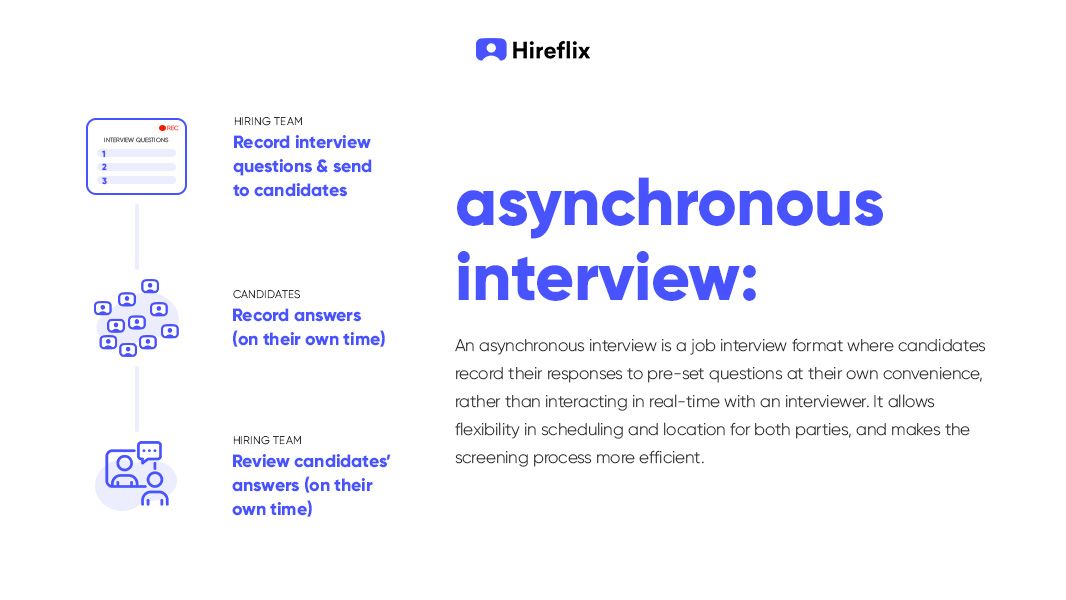
An asynchronous interview (also known as a one-way video interview) is a screening method where candidates record answers to pre-set questions on their own time. Unlike a traditional phone screen or Zoom call, the recruiter and candidate do not need to be online simultaneously. This "time-delayed" format allows hiring teams to review responses at 1.5x speed, decoupling the screening process from the recruiter’s calendar.
Asynchronous vs Synchronous Interviews
The primary difference between these formats is the requirement for real-time interaction.
| Feature | Synchronous Interview (Phone/Zoom) | Asynchronous Interview (One-Way Video) |
|---|---|---|
| Scheduling | Required (scheduling conflicts are common) | Not required (zero friction) |
| Time Commitment | 30–45 minutes per candidate | 3–5 minutes per candidate |
| Consistency | Varies by recruiter mood/fatigue | Identical questions and think-time for all |
| Bias Risk | High (impacted by small talk) | Lower (structured, standardized process) |
How the Asynchronous Process Works
The asynchronous or one way interview workflow replaces the manual "scheduling tag" with a streamlined, three-step automation.
- Setup: The recruiter selects text or video-based questions and sets a "think time" limit (e.g., 30 seconds) and a "max answer length" (e.g., 2 minutes)
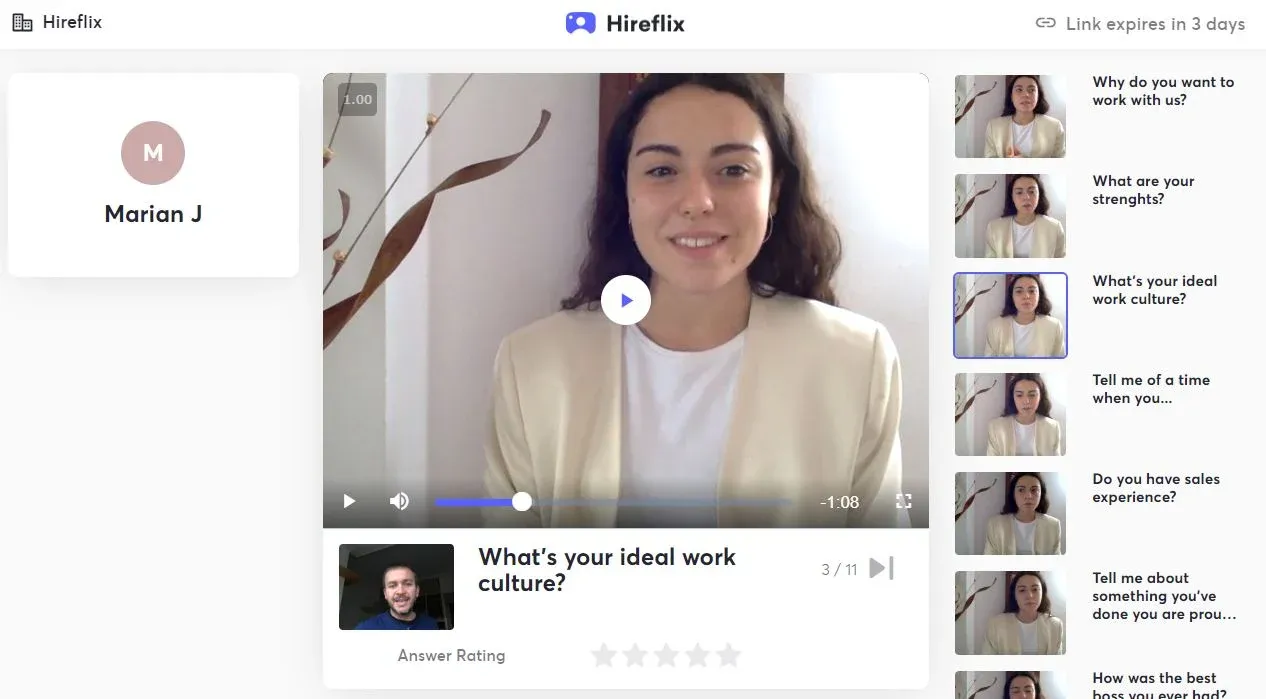
- Candidate Recording: The candidate receives a link via email. They record their responses via browser or mobile device without creating an account
- Review: The hiring team watches the responses, rates the candidate using a scorecard, and shares the best profiles with hiring managers
Benefits of Replacing Phone Screens with Asynchronous Video
Moving from live phone screens to async interviews is not just a technology shift; it is an operational shift in your hiring process. Asynchronous interviewing solves three specific bottlenecks inherent in manual recruiting.
Reduces Screening Time by 80%
Manual phone screens are non-scalable. A recruiter can only conduct a finite number of 30-minute calls per day. Asynchronous video interviews remove the "synchronous tax" of scheduling, small talk, and transition time.
- Manual Process: 30 minutes per candidate × 10 candidates = 300 minutes (5 hours)
- Asynchronous Process: 5 minutes per review × 10 candidates = 50 minutes
Standardizes the Interview Process to Reduce Bias
In a live phone call, a recruiter’s fatigue, mood, or rapport with a candidate can unintentionally influence the outcome. An async interview ensures fairness and guards against unconscious bias by providing every candidate with:
- The exact same questions
- The same amount of "think time" to prepare an answer
- A standardized environment free from interviewer interruption
Improves Collaboration for Hiring Managers
Traditional notes from phone screens are subjective and hard to share. "I liked him" is not actionable feedback. Asynchronous video interviewing creates a shareable asset. Recruiters can send the direct video link to hiring managers, allowing multiple stakeholders to review the candidate’s actual performance rather than relying on a recruiter’s summary.
3 Signs Your Team Needs Asynchronous Interview Software

Not every role requires video screening. However, three specific operational triggers indicate that manual screening is hurting your hiring velocity.
1. You Are Screening High-Volume Roles
If a job posting receives over 50 qualified applicants, manually screening them is mathematically impossible without delaying the process. Asynchronous tools allow you to manage high volume recruitment by screening hundreds of job seekers simultaneously, ensuring no qualified talent is ignored due to recruiter bandwidth limits.
- Best for: Retail, Customer Support, Sales, Internship programs
2. You Are Hiring Across Multiple Time Zones
Scheduling live interviews between time zones (e.g., a London team hiring a developer in Los Angeles) creates delays of 24–48 hours just to find a meeting slot. Asynchronous interviews eliminate the time zone constraint entirely, allowing candidates to record when they are awake and recruiters to review when they are online.
3. You Are Facing Candidate Drop-Off Due to Scheduling
The scheduling ping pong kills candidate interest. If it takes three emails and four days to book a 15-minute chat, prospective employees often accept another offer in the meantime. An asynchronous video interview allows candidates to interview immediately upon applying, capturing their interest at its peak.
The “Candidate Friction” Trap: What to Avoid
The biggest mistake hiring teams make when adopting asynchronous tools is selecting software that creates barriers for the candidate. If the screening process is too difficult, top talent will abandon the application.
Avoid Mandatory App Downloads
Data shows that requiring a candidate to download a mobile app or create a user account to record an interview significantly increases drop-off rates.
- The Barrier: Asking a candidate to install 50MB of software for a 5-minute interaction
- The Solution: Use "link-based" platforms (like Hireflix) that allow candidates to record directly in a mobile or desktop browser with one click
Limit the Number of Questions
Asynchronous interviews are for screening, not for deep-dive technical assessments. Each interview question should be answerable in under two minutes and focus on a single competency to keep the process lightweight for the applicant.
- The Mistake: Asking 10+ questions
- The Best Practice: Limit screens to 3–4 questions maximum – the goal is to determine if the candidate is worth a live interview, not to learn their entire life story
3 Example Questions for Asynchronous Interviews
To get the most value out of a short video response, avoid generic prompts like "Tell me about yourself." Instead, use behavioral questions that reveal how a candidate thinks.
1. The Scenario-Based Question
- Question: "Describe a time a project didn't go as planned. What was the specific roadblock, and how did you handle the communication with stakeholders?"
- Why it works: It tests accountability and communication skills under pressure, rather than just prepared scripts
2. The Constructive Feedback Question
- Question: "Tell us about a piece of constructive feedback you received recently. How did you implement it?"
- Why it works: This reveals coachability and self-awareness – critical traits that are hard to gauge on a resume
3. The “Culture Add” Question
- Question: "What is one thing you would change about your current team’s workflow to make it more efficient?"
- Why it works: This moves beyond "culture fit" (do we like you?) to "culture add" (can you improve us?)
Conclusion: Calculate Your Time Savings
Asynchronous interviews are the most effective way to scale your hiring and recruitment process without scaling headcount. By removing the administrative burden of the phone screen, you free up your recruiting team to focus on closing candidates rather than scheduling them.
The math is simple: If you screen 20 candidates a month, you are likely spending 10+ hours on phone calls. With an asynchronous video interview platform, that drops to 2 hours.
Next steps: Test the process yourself. Start a free trial with Hireflix today – no credit card required and no app for your candidates to download.
