One Way Interviews: We Analyzed 1,820 Recruiter Reviews To See Why They Work


Updated February 10, 2026
Most hiring teams agree on one thing: the traditional phone screen is broken. It’s a logistical nightmare of "calendar Tetris," missed calls, and repetitive questions that eats up hours of your week.
The industry solution has been the one-way interview (also known as an asynchronous video interview).
But is it actually efficient, or just a way to alienate candidates?
To answer this, we didn't just guess. We analyzed 1,820 verified reviews from recruiters and HR professionals across G2, Capterra, and TrustRadius to understand exactly why companies adopt this technology.
Here is what the data says about the state of one-way interviewing.
Key Takeaways
- It’s not about replacing interviews: It’s about replacing the phone screen
- Efficiency is the #1 driver: 78% of recruiters cite time savings as the primary benefit, cutting screening time by up to 60% when reviewing multiple candidates.
- It creates fairness: Despite candidate concerns, recruiters view the structured nature of one-way interviews as a tool to reduce bias compared to unstructured phone calls
What is a One-Way Interview?
A one way interview is an asynchronous screening method where candidates record video answers to text or video-based questions. Unlike a live interview (Zoom or in-person), the interviewer is not present.
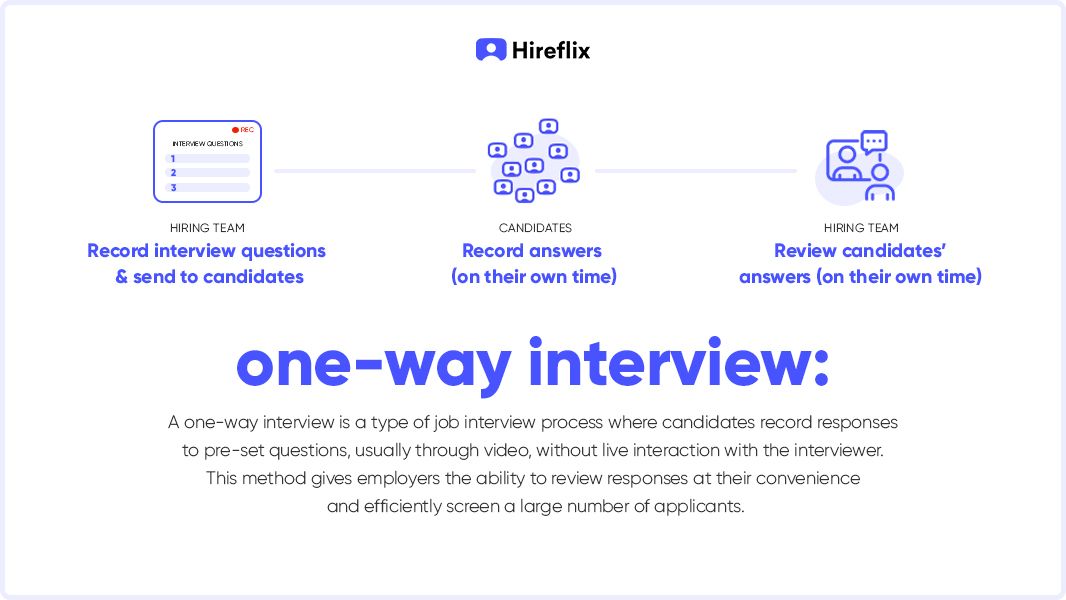
The workflow is simple:
- Recruiter sets the interview questions.
- Candidate records answers on their own time.
- Hiring Team reviews the videos when convenient.
While often criticized by candidates as "impersonal," our analysis of the market data shows that for modern HR professionals, it is the single most effective tool for scaling the hiring process and supporting a faster hiring decision.
The 5 Things Recruiters Love About One-Way Interviews
We conducted a thematic analysis of 1,820 reviews to rank the benefits of one-way interviews by frequency. Here is why talent acquisition teams are making the switch.
1. Massive Time Savings (78% of mentions)
The most dominant benefit, cited by 78% of recruiters, is raw speed.
In a traditional process, a phone screen takes 30–45 minutes. With a one-way video interview, a recruiter can review a candidate’s responses in 5 minutes, often watching at 2x speed.
The Impact:
- Screening Time: Reduced by up to 60%
- Time-to-Hire: One case study showed a drop from 29 days to just 12 days
- Hours Reclaimed: Recruiters report saving 20+ hours per hire
This isn't just about working less; it's about reallocating time. By automating the low-value administrative task of candidate screening, recruiters can focus on high-value tasks like closing offers.
2. Elimination of Scheduling Logistics (61% of mentions)
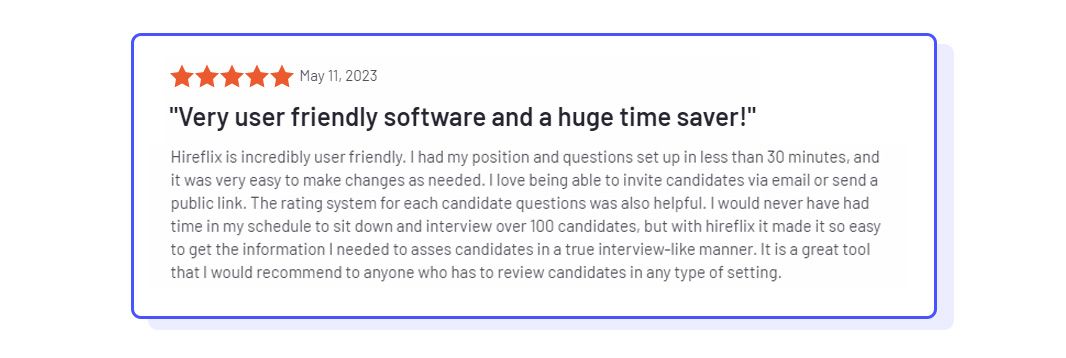
The second most cited benefit is the removal of friction. Recruiters consistently refer to the "logistical nightmare" of scheduling live calls across time zones.
For global teams or passive candidates who are already employed, the asynchronous nature of the one-way or pre-recorded interview is a game-changer. It allows a candidate in London to record at 8 PM, and a hiring manager in New York to review at 9 AM the next day.
3. Hiring Team Collaboration (49% of mentions)
One of the biggest bottlenecks in hiring is the hiring manager. Getting a busy manager to commit to ten 30-minute phone screens is nearly impossible.
Our analysis found that one-way interviews increase manager engagement. Because managers can review videos in 15-minute bursts between meetings, they are more willing to participate early in the interview process.
From the reviews:
"Async interviews are absolutely a time saver, and having the interviews recorded helps more colleagues join the evaluation of new hirings." (TrustRadius)
4. Standardized Fairness (35% of mentions)
There is a significant disconnect here between candidate perception and recruiter reality. Candidates often feel video interviews introduce visual bias. However, 35% of recruiters explicitly cite bias reduction as a key benefit.
Why?
In a phone screen, interviewers often stray into "chatting," leading to affinity bias. In a one-way digital interview, every candidate answers the exact same questions under the same time constraints. This structure creates a "level playing field" that is more legally defensible and objective than a casual phone chat.
5. Deeper Candidate Insight (31% of mentions)
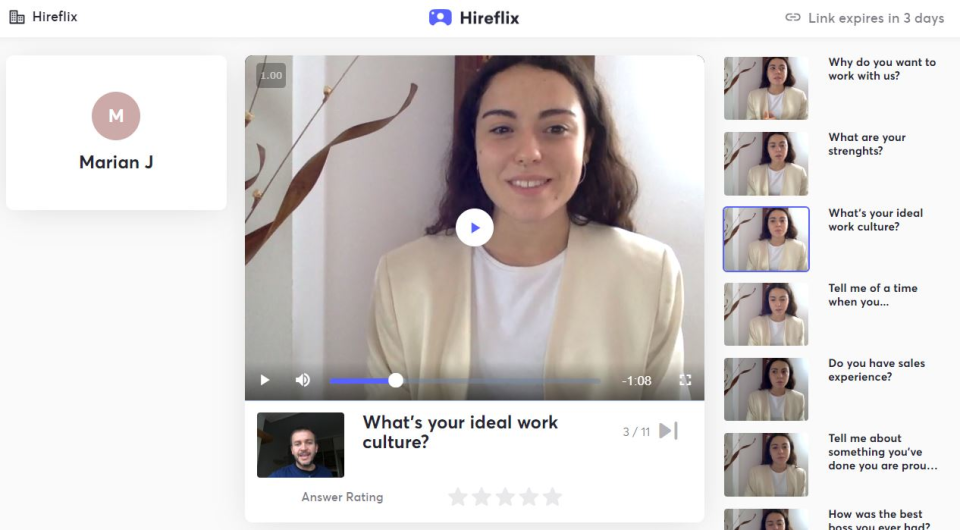
Resumes are often "polished narratives" that all sound the same. Video gives you a 3D view of the candidate before you commit to a live meeting.
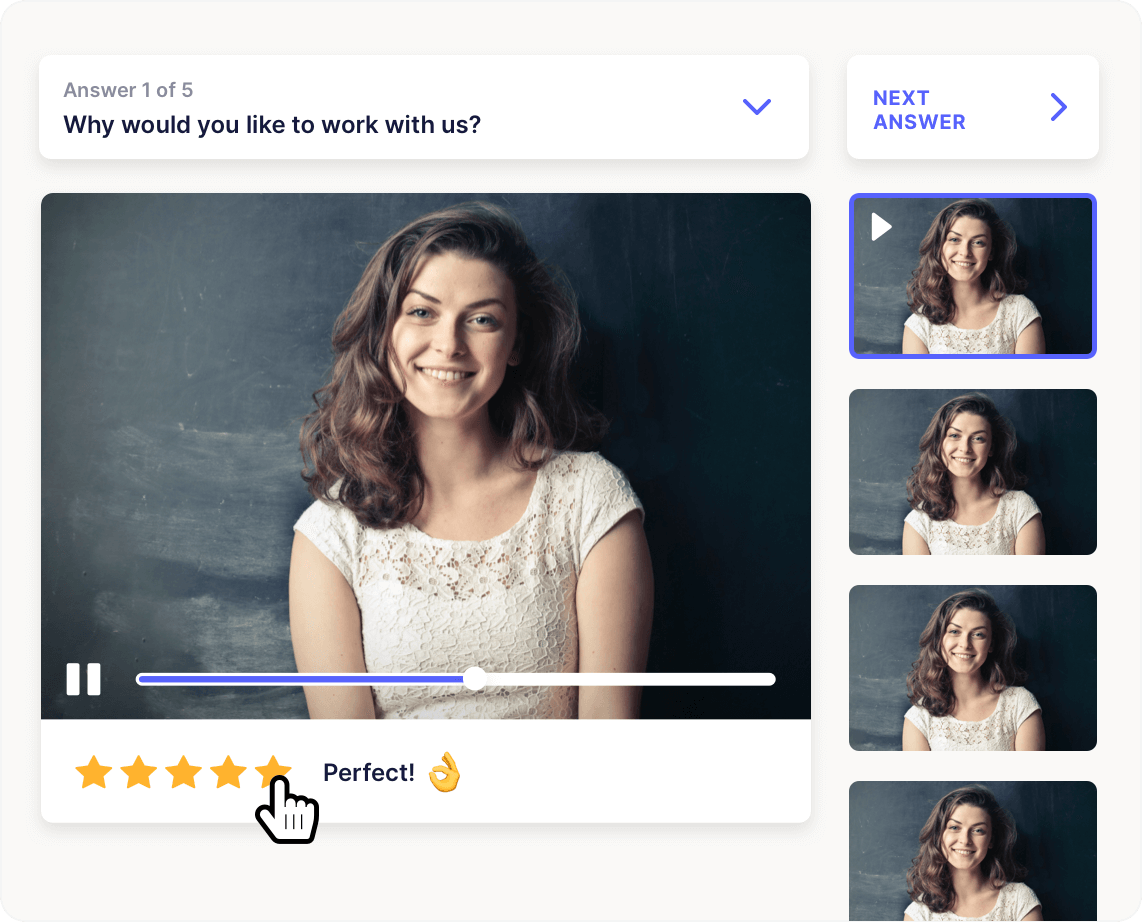
Recruiters use this to test "soft skills" early, specifically communication, professionalism, and authenticity. It functions as a risk-reduction tool, ensuring the person on paper matches the person in reality.
Is one-way interviewing only for high-volume hiring?
A common misconception is that asynchronous interviews are only useful for staffing agencies or retail giants processing thousands of applicants.
Our analysis of the data shows this is false. While "speed" is the universal benefit, the primary driver for adoption changes significantly depending on the company size.
We analyzed specific feedback from two distinct recruiter personas, Staffing Agencies vs. Corporate Teams, to see how their motivations differ.
Comparison: Staffing vs. Corporate Priorities
| Feature | Staffing / High-Volume Agencies | Corporate / Enterprise Teams |
|---|---|---|
| Primary Driver | Speed & Scale | Collaboration & Compliance |
| Main Pain Point | Unmanageable volume; "buried in emails" and "calling dozens" of people. | Hiring manager bottlenecks and meeting DEI/standardization goals. |
| Goal of Software | "Screen candidates in bulk" to survive the influx. | Drive "manager engagement" and ensure a fair and unbiased evaluation. |
| Value of Brand | Secondary to speed. | Critical; they view the tech as a way to create a "professional impression." |
The Bottom Line: If you are a high-volume hirer, you need it for scale. If you are a boutique agency or SMB, you need it for consistency and time-reallocation.
How to Choose the Right One-Way Interview Platform
There are dozens of video interview tools on the market. To understand how to choose, we looked at how user sentiment varies across the major software review platforms: G2, Capterra, and TrustRadius.
The data reveals that different platforms attract different types of buyers, highlighting exactly what you should look for based on your needs.
1. The Tech-Savvy Buyer (G2 Trends)
Reviews on G2 heavily emphasize functionality. Users here care most about "interoperability" (integrations with ATS), "performance," and "ease of setup".
- Takeaway: If you have a complex tech stack (e.g., Greenhouse, Lever), prioritize tools that mention strong integration capabilities in their G2 reviews.
2. The Value-Focused Buyer (Capterra Trends)
Capterra users prioritize affordability. The dominant themes in these reviews are "value for money" and "ease of use".
- Takeaway: If you are an SMB or budget-conscious agency, look for platforms that offer transparent pricing and are praised for simplicity on Capterra.
3. The Security-Focused Buyer (TrustRadius Trends)
TrustRadius focuses on in-depth, long-form reviews. These users are often enterprise stakeholders validating "trustworthiness" and vendor support.
- Takeaway: For enterprise deals where security and support are non-negotiable, look for platforms with verified presence and detailed case studies on TrustRadius.
The Verdict
One-way interviews are not a replacement for the human connection of a final job interview. They are a replacement for the inefficient phone screen.
If your team is drowning in scheduling emails, struggling to get hiring managers involved, or taking 45 days to fill a role, the one-way interview offers a proven, data-backed ROI for employers:
- Cut screening time by half.
- Eliminate scheduling conflicts.
- Standardize your evaluation.
Ready to reclaim your calendar?
